Showing posts with label Curtain Rods. Show all posts

Monday, August 31, 2026

Which Curtain Rod Finish Fits Your Room?

Satin Gold vs. Antique Brass vs. Matte Black vs. Walnut


Choosing a curtain rod finish — brass, metal, or wood — feels like a bigger decision than it actually is. A customer came in last week stuck on hers; we matched her finials to the posts on her four-poster bed and had it settled in about five minutes. Most of the time it really is that simple: pull the finish from your wood blinds, your furniture knobs, or your ceiling fan, and you're most of the way there. 

The rod lives at eye level, runs the full width of the window, and stays put for years, so it earns a little thought — just not the week of agonizing it usually gets. Here's how the four finishes we get asked about most actually behave in a real room.

Satin Gold

This isn't the shiny polished brass your grandmother had on the bathroom faucet. Satin gold is warm, brushed, and soft — a metallic that catches light without shouting about it. It plays beautifully with creams, warm whites, greens, and navy, and it sits right next to warm wood tones like it was always meant to be there. If your room leans transitional or modern with a warm streak, satin gold is the finish that makes a window look pulled together without looking fussy. It's earned its popularity honestly.

Antique Brass

Antique brass has some age baked into it — a little brown, a little patina, none of that mirror shine. That's the whole point. It reads traditional and old-world, and it's the natural partner for jewel tones, darker woods, and rooms that already have some history to them. Practically speaking, it's one of the more forgiving finishes we sell: it doesn't show fingerprints, it doesn't flag every speck of dust the way a bright finish does, and it tends to look better the longer it's up. If you love a classic, layered room, this is your finish.

Matte Black

Matte black is the graphic one. It frames the window like a line drawing and gives a space instant definition — which is exactly why it works across so many styles, from modern to farmhouse to a little industrial. Set against white or pale walls, it's crisp and architectural. The one honest caution: in a small room where everything's already pale and soft, a heavy black rod can feel like it's doing a lot. But if you want contrast and structure — if you want the window to be a feature and not a whisper — matte black delivers every time.

Walnut and Wood Finishes

Wood does the opposite of black. Instead of announcing the window, it softens and warms it, letting the rod settle into the room rather than draw a hard line across it. Walnut and other wood tones are wonderful in bedrooms, traditional spaces, and any warm neutral room where you want everything to feel calm and cohesive. Here's a bonus most people don't think about: if you already have wood blinds or wood furniture, a wood rod ties the whole window back to what's already in the room. It blends where black contrasts.

So How Do You Actually Pick?

Start with what's already in the room. Look at your other metals and woods — cabinet hardware, light fixtures, faucets, furniture legs. Rods don't have to match those exactly, but they should belong to the same family: warm with warm, cool with cool. Then ask yourself one question — do you want the rod to blend in or stand out? If you want it to disappear, go wood or pick a finish close to your wall color. If you want it to frame and define, go matte black or a metal with some contrast. Last, factor in the room itself. A big, bright room can carry a bold rod; a small, soft one usually wants a finish that doesn't fight for attention.

Shop Curtain Rods


And here's the part that actually matters: there's no wrong answer that a magazine gets to decide for you. If you love a finish, it fits your room. Decorate what you love — the rest is just details.

We carry curtain rods in all four of these finishes and plenty more, in stock sets and custom lengths, from brands like Vesta and Kirsch. If you're not sure how a finish will read against the woods and metals you already have, we can send you color chips so you can hold them up in the room and match for yourself — a lot easier than guessing from a screen. Give us a call or drop us a line anytime, and we'll get some chips headed your way.

Monday, June 29, 2026

The Curtain Rods We Shipped to a Gilded Age Mansion

We recently had the privilege of partnering with a designer to create a custom solid‑brass curtain rod system — the kind of detailed, made‑to‑measure work our shop does day in and day out. What made this project special wasn’t the rods or the finials, but their destination: the historic Barker Mansion in Michigan City, Indiana, a 38‑room English Manor house turned museum and listed on the National Register of Historic Places since 1975.

We didn't do the window treatments. We want to be straight about that, because we're proud of what we did do and there's no reason to dress it up. The drapery and the rest of the design work belong to other hands. What came from us was the hardware — and in a room like this one, the hardware matters more than people think.

What went up in that room

The rods and finials are from the Vesta Castilian collection, solid brass, 1 3/8" diameter. If you've spent any time around drapery hardware, you know "solid brass" and "brass-look" are two very different animals. A lot of what's sold today is steel or aluminum with a brass-colored finish baked on. It looks fine in a photo. It does not have the weight, and it does not age the same way. Castilian is the real thing — heavy in the hand, traditional in its lines, the kind of rod that belongs in a house full of original furnishings rather than fighting with them.

You can see why it works in the photo the mansion let us share. Sage-green pinch-pleated panels with a banded hem, hung over delicate lace sheers, against floral wallpaper in a twin-bed guest room. The brass rod runs straight across the top and lets the eye go right to the window — which, given the leaded glass in that house, is exactly where you want it to go. The hardware doesn't shout. It just holds everything up and looks like it was always there. That's the whole job.

Why solid brass earns its keep on heavy drapery

Here's the practical reason this isn't just a matter of taste. Lined, pleated drapery is heavy. Full-length panels with a proper lining can run several pounds per side, and a hollow rod with lightweight brackets will start to sag in the middle or pull loose at the wall over time. Solid brass holds a long span without bowing, and it takes a real bracket and a real screw into a real anchor. For a wide window — and the windows in a house like Barker are tall and wide — that rigidity is the difference between drapery that hangs clean for twenty years and drapery that develops a smile in the rod by year two.

It's also the difference you feel every time you draw the curtains. A good brass rod and a quality ring move quietly and smoothly. A cheap one announces itself.


You don't have to own a mansion

The point of telling you this isn't that we did one fancy job. It's that the same Castilian rod that went to a historic museum is the same one we'll sell you for the dining room you've been meaning to finish. We ship drapery hardware all over the country — that's a big part of what we do at InteriorDecorating.com — and the brass that's good enough for a National Register house is sitting in the same catalog as everything else.

If you're working on an older home, or a newer one you want to feel settled and traditional, solid brass is worth the difference in price. Measure your window, count your panels, be honest about how heavy your drapery is, and size the rod to the job. If that last part makes your eyes glaze over, that's what we're here for.

We've been doing this a long time, and there's not much in the way of windows, rods, brackets, and "will this hold?" that we haven't seen. If you've got a project — a single stubborn window or a whole house — give us a call or send an email through InteriorDecorating.com and we'll help you get the hardware right the first time. 

Our thanks to the Barker Mansion for letting us share the room. If you're ever up that way, it's worth the tour.

Friday, February 24, 2017

How Many Curtain Rings Do I Need?

Curtain Rings

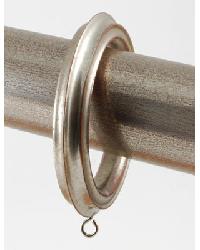
Do you want to add some flair to your curtain panels?  Curtain rings are the popular choice.  So how many curtain rings do you need?  The general rule is to place a ring every four to eight inches.  Well, that's still pretty vague.  If your curtain fabric is heavy you need more rings so measure every 4 inches.  If you have light weight curtains, every 8 inches will be sufficient.

Here's the math:

Length of curtain rod / 8 = Minimum number of rings
Length of curtain rod / 4 = Maximum number of rings


Shop Curtain Rings >>

Tuesday, February 18, 2014

Curtain Rod Question


Question: 
I am looking for a traverse rod to cover a arched top window with traverse drapery panels. Will the Item #: 75006 Heavy Duty Flexible Curtain Track work for this shaped window and application?
Also is this rod strong enough if the panels are going to be 80" wide 196" long?
I also have 2 straight windows on the sides, would the same rod work for this if I do not need it to be flexible or is there a coordinating straight rod?
Flexible Curtain Track
 
Answer:

That rod is strong enough to hold the weight of panels you are describing if enough brackets are put into something secure. The rod is also able to be made straight. However, it is not designed to arch in the manner in which I am thinking you are wanting to use it, which is make it arch around the window. Yes, you can do that and hang stationary panels and valances. The reason it would be difficult to use these as a traversing rod is that you would be fighting against gravity in trying to pull the panels up and then keep them.  Also the length of the drapes would be an issue, as the center part and sides of the traversing drapery panels would be at varying heights when traversed.


Wednesday, August 10, 2011

Drapery Hardware Terms Made Easy

Bracket
A solid piece of material used to mount or attach curtain rods to the wall, molding, window trim, or ceiling.

Center Bracket
A single or double bracket made to mount over the top of a window to support additional weight in the center of the rod.
Clearance
The distance from the mounting surface to the back of the curtain rod. Important consideration if an under treatment is to be used.

Diameter
The length of a straight line that runs through the center of a circle, cutting it into two symmetrical halves. Commonly used to describe the size of a pole or finial.
Finial
A decorative element attached to one or both ends of a rod that also prevents rings and panels from sliding off the end of the rod.

Pin-on Hook (Drapery Pin)
A metal pin designed to slide into draperies, and then to attach (hook) to a ring or slide.

Projection
Distance from wall to the front of the rod.

Return
The drapery fabric that covers the area from the end of the curtain back to the wall. In shirr-on curtains, the fabric is eased around the corner of the curtain rod. In pin-on draperies, an additional pin is used at the outside top corners of the drapery and hooked into the rod bracket hole.

Tuesday, March 18, 2008

Finials and Standards and Pulleys, oh my!

Window Covering! You either love to be covered or don't mind being open to the world - there seems to be strong feelings on both sides of the debate. Personally, I prefer my windows covered - it is way easier to hide a messy interior that way ;) There are so many styles of window coverings that are available, from blinds to valances to roman shades - the possibilities are endless!

One thing we get asked more than anything is "can this be made into a traverse rod?" More often than not, the answer is no. Traverse rods are intended for draperies that you want to be able to open and close with a pulley mechanism, which pulls the drapes open from the center, or as a "one-way draw", which would open them to the right or to the left only. These systems use a pulley system, rather than manually moving the curtains. They differ from a rod that uses rings or tab-top drapes in that you have to manually move those with a baton or by hand.

With regards to traversing track, there are also your more "industrial" options, flexible tracking and cubicle tracking-type systems. The flexible tracking is just that - flexible. You can make it follow most any pattern you need, from straight to a 360-degree circle. The cubicle tracking systems are more like what you would find in a hospital/doctor's office setting and are typically use for applications which require straight sections or sections with a 90-degree curve.

Another system that has become more popular is a wire system. These types of systems use steel wire held between two or more brackets and can use small rings to slide your curtain along the wire. They are very popular in areas where you may have little room for drapery hardware.

Along
with the decision of the type of hardware, you must also decide the type of drapery style you wish. There are different types of pleats (i.e., goblet pleat, pinch pleat, knife pleat, etc.), tab-top, rod-pocket styles as well as swags, jabots, puddles - it's unreal how many choices there are!

There are also other options which do not necessary require rods or curtains. Roman shades,
blinds, roller-shades - take a look!
(photo copyright to www.simplesewingprojects.com )

After you've decided on a style, you get to find a fabric and that can be the most fun of all!

Friday, February 15, 2008

How to Measure for Curtains and Window Treatments

Here is a neat video from You Tube that illustrates how to measure your window for curtains and window treatments. There is some great info here!

Unusual Use of Tension Rod

My favorite decorating tip that I use myself: use a tension rod in your pantry to separate your cookie sheets and other flat pans. It works just like you had those fancy slots in your cabinets - tension rods are cheap. Just measure your shelf height and buy the right tension rod. This idea came from Martha Stewart. Tension Rods at InteriorMall.com